

Little Cocalico has built a reputation for high-quality digital printing on natural fabrics. In this Q+A, President Jon Boll reflects on the company’s journey, evolving customer demands, and the role trusted material partners like Premex Solutions play in delivering consistency at scale.
Origins and mission
For those who may not know Little Cocalico, how would you describe the company and the values that underpin your operation?
Little Cocalico is a family-owned, family-run digital textile printing company based in Pennsylvania. The business grew out of my wife’s background in fabrics, particularly in children’s clothing and a shared desire to work together while having more control over quality and production. From the beginning, our focus has been on natural fibers, thoughtful processes and building something that supports both our customers and our family. Being able to stay closely connected to our work and our people is still central to how we operate.
What sets your approach to textile finishing apart in a market that’s becoming increasingly competitive?
From early on, we felt the market needed better quality custom printing, particularly on natural fabrics. Natural fiber printing is more challenging and more expensive to get right, but it is where we chose to focus. While competition has increased, especially in polyester and apparel printing, our emphasis on natural fabrics, consistency and print quality has helped us stand out.
Market and customer needs
What challenges do your customers bring to you most often and how do you solve them better or differently than others in the space?
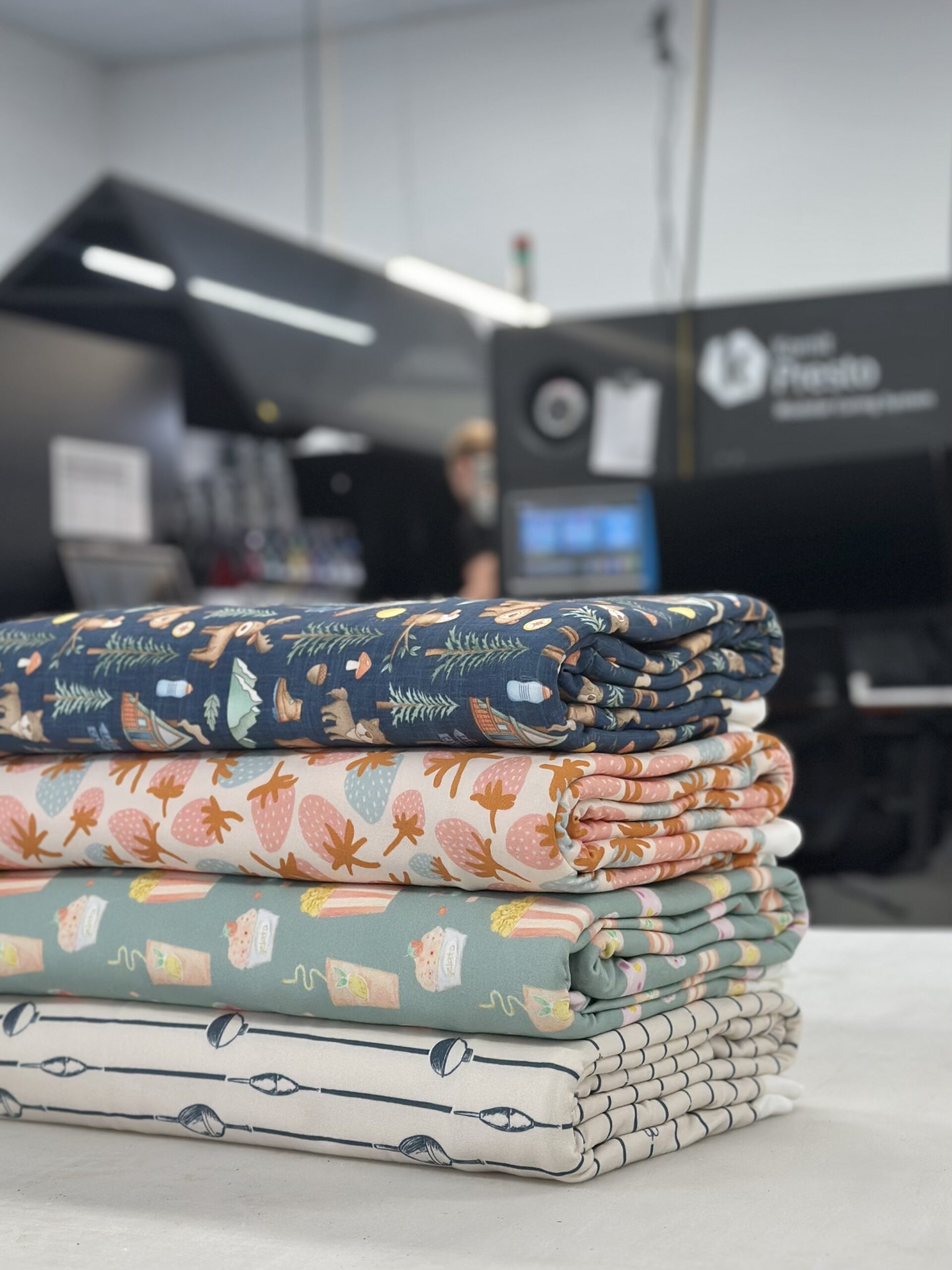
Most of our customers come to us as a print service provider. They range from very small independent brands to large established names. What they have in common is the need for high-quality digital printing without large minimum orders. As long as a customer brings us a strong digital file we can print it on the right fabric for their application. Digital printing allows us to support short runs, flexibility and a wide range of end uses, from fashion and quilting to home interiors.
Operations and technology
Little Cocalico has built a reputation for craftsmanship and consistency. What operational practices or technologies enable that?
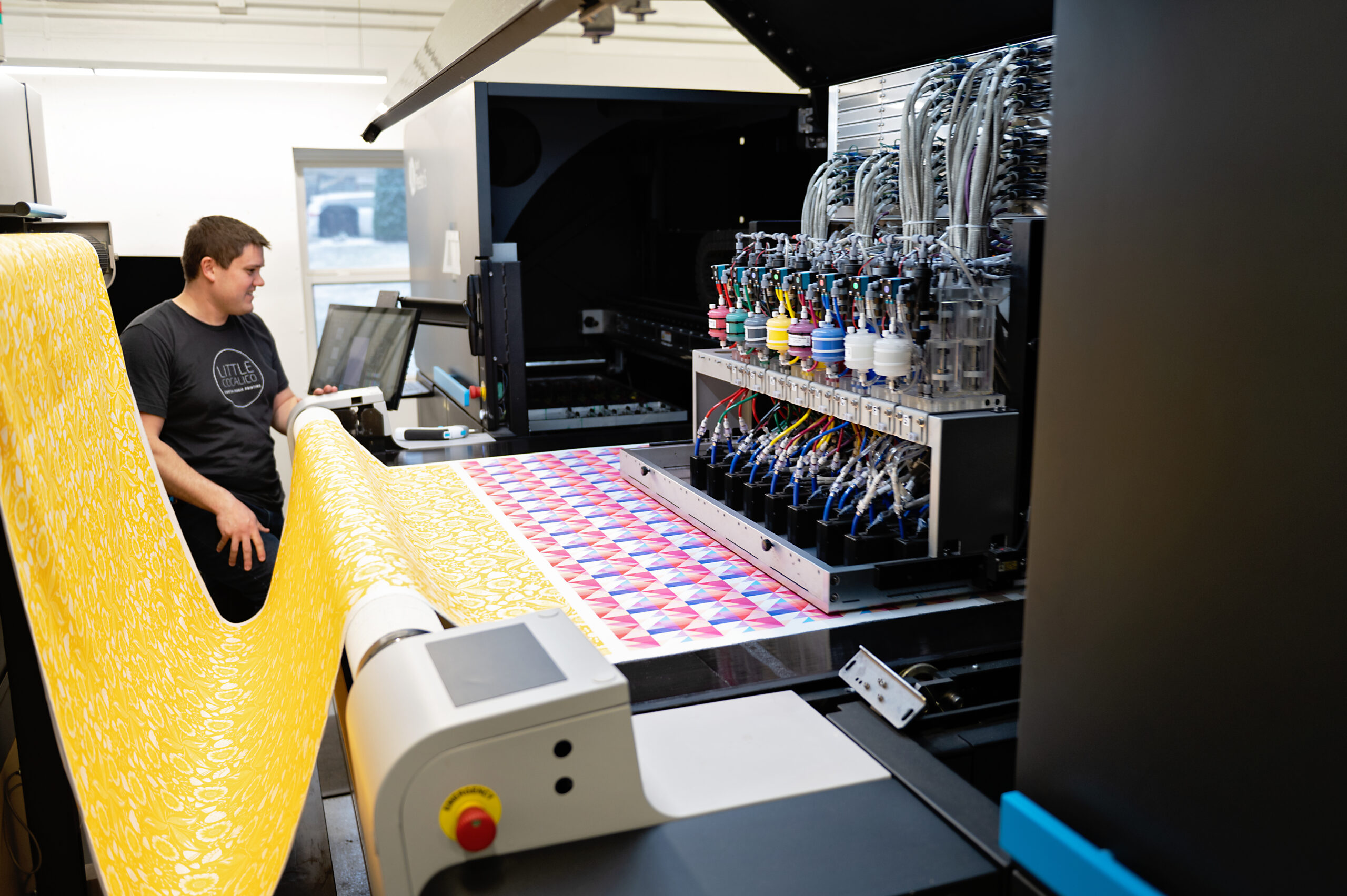
We run Kornit Presto printers and have had excellent results with them. One of the biggest advantages is the ink technology. The inks are water-based, certified organic pigments and the fixation process is built directly into the printing. That means no pre-treatment, no post-treatment and no ink waste. Fabric comes off the machine cured and finished. This allows us to print directly onto untreated natural fabrics while maintaining consistency and quality.
And what role does innovation play?
Innovation is critical, especially when it simplifies processes while improving outcomes. For us, innovation that reduces waste, supports natural fabrics and delivers reliable results is what really matters. Technology that allows us to print efficiently without additional chemical steps aligns closely with how we want to operate.
Sustainability and standards
How are sustainability expectations changing, and how is Little Cocalico responding in both practice and product?
Sustainability has been part of who we are from the beginning, particularly through print-on-demand. When we started, it was not widely discussed in the US market but that has changed. More customers and competitors are now paying attention. Our commitment goes beyond printing methods. It is also about health, what people wear, what they bring into their homes and how those products are made. We believe education is key. As people understand textile processes better, demand for sustainable and responsibly produced materials naturally increases.
Working with Premex and PrepRITE™
What made you choose Premex Solutions as a partner, and how does our relationship support your production goals?
What stood out immediately was the quality of the fabrics and the care Premex puts into what they produce. On the woven side, especially organic wovens, there are not many high-quality options available in the market. Premex filled that gap for us. Equally important is the customer service. Being responsive and flexible is critical in a print-on-demand environment, where demand can change quickly. Having a supplier that is willing to move fast and work with us makes a real difference.
How have PrepRITE™ fabrics performed in your workflow and what differences have you seen compared to other digitally prepared materials?
Even though we work with untreated fabrics rather than coated ones, we have seen consistently strong performance from Premex fabrics. They are clean, well-prepared and print reliably. We work with high-end suppliers across the board, but we have experienced issues elsewhere with inconsistency. That has not been the case with Premex.
Are there particular product lines or customer applications where PrepRITE™ has had the biggest impact?
The biggest impact has been in the home interior space. We have seen strong demand for sheer linens and recently launched a natural linen-cotton blend from Premex, both of which have performed very well. Home interiors have become a major growth area for us.
Customers, growth and industry direction
What are your customers asking for today that they weren’t asking for one, three or five years ago?
When we started, our focus was heavily on knits and children’s apparel. Over time, customers began asking for more woven fabrics, particularly for quilting, crafting and home interiors. Responding to those requests has driven a lot of our recent growth.
Where do you see the biggest opportunities for digital print and finishing in the next three to five years?
Digital printing will continue to grow as brands demand shorter lead times, smaller runs and more flexibility. Even larger brands are being forced to adapt quickly to changing demand. Consumers want custom products and do not want what everyone else has. Nearshoring and producing closer to where products are sold will also become increasingly important, especially in the US. Print-on-demand and digital production are well positioned to support all of this.
What growth areas is Little Cocalico most focused on as you look ahead?
We see continued opportunity across wovens and home interiors, alongside supporting brands that need speed, flexibility and consistent quality. As digital demand grows, we aim to scale responsibly while maintaining the standards that define our work.
Human side and leadership
What keeps you most motivated leading Little Cocalico?
For me, it comes down to serving people. Our customers and our team. The human side of the business is what drives me every day.
Final insights
What inspired the name of your company?
The name Little Cocalico comes from our local area. There’s a creek that runs through the town where we live called Little Cocalico Creek. It was meaningful to us personally and it also stood out in the market.
If there’s one thing you wish people understood better about the digital textile supply chain, what would it be?
I wish more people understood the long-term impact of their purchasing decisions. Fast fashion continues to grow because of price pressure, but the long-term effects are often overlooked. Buying quality products and choosing sustainable options has real consequences for health, the environment and future generations. Helping people understand that value is incredibly important.